Data Analytics, Financial Services, Business Intelligence
Banking Transactions & Customer Analytics Dashboard
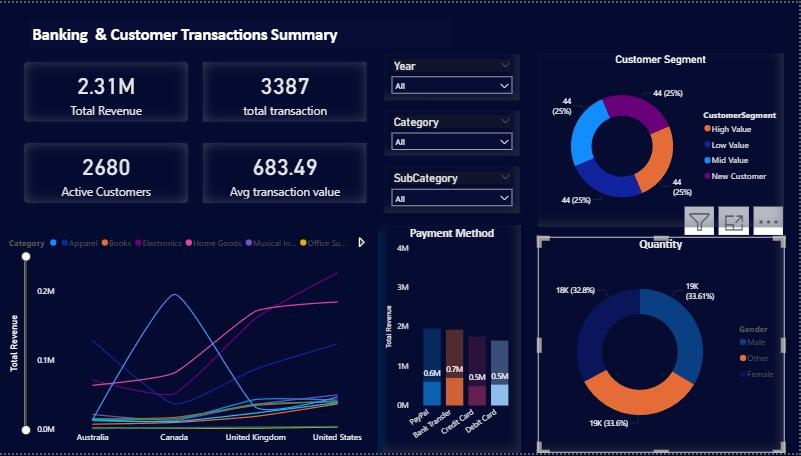
An interactive Power BI dashboard designed to analyze banking transactions and customer behavior across geographies, enabling data-driven insights for revenue, customer segmentation, and payment trends.
Project Detail
Context
Banks and financial institutions generate large volumes of transactional data,
but decision-making often relies on static reports or fragmented views of
customer activity.
To be useful, analytics dashboards must go beyond visualization and enable
clear interpretation of revenue drivers, customer behavior, and geographic
patterns.
What I Built
I developed an interactive Power BI dashboard that consolidates banking
transaction and customer data into a single analytical view.
The dashboard is designed to help stakeholders quickly understand how revenue,
customer segments, and transaction behavior vary across regions, categories,
and payment methods.
What the Dashboard Enables
The dashboard provides:
- Revenue and transaction-level performance metrics
- Active customer tracking and average transaction value
- Geographic analysis across key global markets
- Customer segmentation by demographics and behavior
- Category and subcategory-level transaction breakdown
- Payment method analysis across different transaction types
Interactive filters allow users to dynamically explore trends by year,
category, and subcategory without rebuilding reports.
Design Decisions That Matter
The focus was on clarity and usability:
- KPIs prioritized at the top for immediate visibility
- Geographic and segment-level views to identify concentration risk
- Filters designed to support exploratory analysis, not static reporting
- Visual hierarchy optimized for executive-level consumption
The dashboard emphasizes interpretability over visual complexity.
Why This Matters
This project demonstrates the ability to translate raw transactional data into
decision-support analytics for financial services use cases.
The same approach applies to:
- Retail banking analytics
- Customer profitability analysis
- Transaction monitoring and reporting
- Business performance dashboards for finance teams
It highlights how structured analytics can support informed decisions without
requiring advanced modeling.